March 23, 2026 – AI Daily Recap

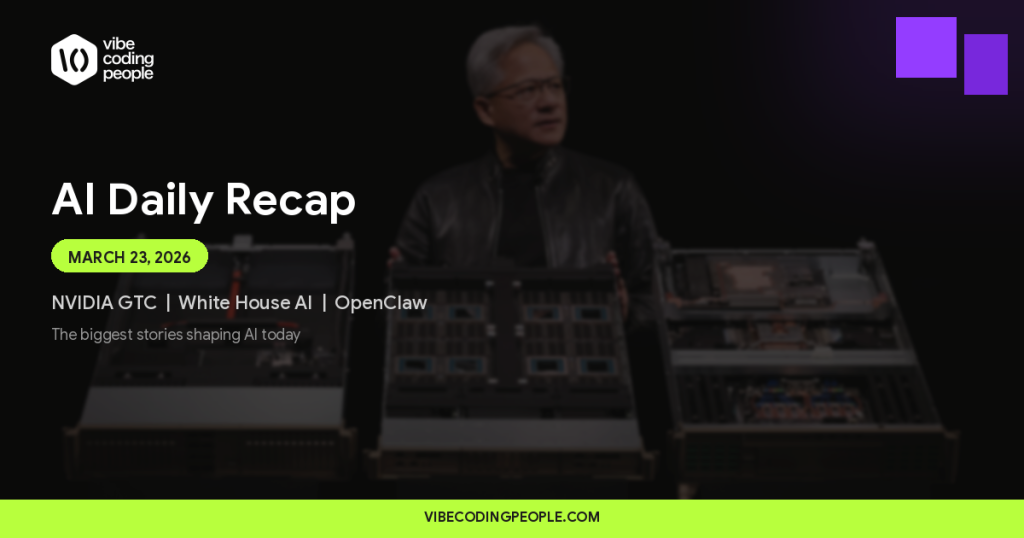
The AI industry closed out the week with a flurry of activity — from Nvidia’s trillion-dollar ambitions at GTC 2026 to a sweeping new federal AI framework from the White House, plus a wave of open-source model releases that are quietly reshaping the competitive landscape. Here’s everything that matters.
Nvidia GTC 2026: $1 Trillion in Orders, Vera Rubin, and the Agentic AI Pivot
Nvidia’s annual GTC conference dominated headlines this week as CEO Jensen Huang laid out a vision that reframes the entire AI compute economy. Huang revealed that he expects purchase orders for Blackwell and Vera Rubin hardware to reach $1 trillion through 2027 — nearly doubling previous projections. The Vera Rubin platform, a rack-scale supercomputer purpose-built for agentic AI that pairs a new Nvidia-designed Vera CPU with the Rubin GPU architecture, is set to ship later this year.
On the desktop front, the DGX Station GB300 packs 748 gigabytes of coherent memory and up to 20 petaflops of AI compute into a deskside form factor, capable of running open models up to one trillion parameters. But the biggest thematic shift was what Huang called the “inference inflection” — the transition from training-driven to inference-driven AI as models reason, plan, and execute tasks autonomously. Nvidia also launched NemoClaw, its enterprise reference stack built on the viral OpenClaw project, and announced the Nemotron Coalition — an open frontier model initiative that includes Perplexity, Mistral, Black Forest Labs, Cohere, and Reflection.
White House Unveils National AI Legislative Framework
On March 20, the Trump Administration released a comprehensive national AI legislative framework built on six core pillars: child protection, community and economic strengthening, intellectual property and creator rights, free speech protection, innovation dominance, and workforce development. The framework’s most consequential provision is its push for federal preemption of state AI laws, explicitly warning against “a patchwork of conflicting state laws” that could undermine national competitiveness.
The framework directs the Attorney General to establish an AI litigation task force to challenge state regulations deemed inconsistent with federal policy. It also calls for streamlined permitting for data centers, on-site power generation, and a “light-touch” regulatory approach that favors innovation over compliance burdens. Industry reaction has been mixed, with some welcoming regulatory clarity while others worry about weakened consumer protections at the state level.
OpenClaw Becomes the Most-Starred Project on GitHub — and Sparks a Commodity Debate
The open-source AI agent platform OpenClaw — originally launched as “Clawdbot” by Austrian developer Peter Steinberger in November 2025 — has surpassed React to become the most-starred software project on GitHub at over 250,000 stars. Unlike typical chatbots, OpenClaw actually executes tasks: running shell commands, reading and writing files, browsing the web, and managing calendars and email.
That explosive growth has also raised alarms. Security firm CrowdStrike flagged concerns about exposed instances, with Censys identifying over 21,000 publicly accessible OpenClaw deployments. China has moved to restrict state agencies from using the platform, and CNBC reports the project is fueling concerns that AI models are becoming commodities — powerful capabilities available to anyone for free, eroding the moats of commercial AI providers.
OpenAI Plans to Nearly Double Its Workforce by Year-End
OpenAI is planning an aggressive hiring push to grow from approximately 4,500 employees to around 8,000 by the end of 2026, according to a Fortune report citing the Financial Times. The new hires will focus on product development, engineering, research, and sales, with the company taking additional office space in San Francisco to bring its total footprint to over one million square feet.
The expansion reflects the intensifying race between OpenAI, Anthropic, and Google to capture enterprise clients — particularly in the booming AI-powered coding assistant market. It also arrives alongside OpenAI’s new Skills feature for ChatGPT, which introduces reusable, shareable workflows that can bundle instructions, examples, and code, applying them automatically when helpful.
A Quiet Wave of Open Model Releases
While the big names grabbed headlines, a string of new model releases on March 22 signaled just how fast the open-source AI ecosystem is moving. Alibaba’s Qwen 3.5 Small (9B) matches 120-billion-parameter models on GPQA Diamond benchmarks while running offline on recent iPhones with just 4GB of RAM. Miro Lab’s MiroThinker 72B uses internal verification cycles to hit 81.9% on the GAIA benchmark — comparable to GPT-5 on reasoning tasks — and it’s fully open source.
Moonshot AI’s Kimi K2.5 is now available on Cloudflare Workers AI for edge deployment, with a 256,000-token context window optimized for multi-step agentic tasks. And Cloudflare itself shipped Bonk, an automatic code review agent built on Kimi K2.5 with GitHub integration aimed at small teams. The common thread: capable models are getting smaller, faster, and more accessible.
Anthropic Launches the Anthropic Institute, Fights Pentagon Designation
Anthropic made two significant moves this week. The company announced the Anthropic Institute, a new research body focused on studying the economic, societal, and security impacts of advanced AI. Separately, Anthropic is fighting a U.S. Defense Department “supply chain risk” designation through the courts — a dispute rooted in the company’s stance on how its models may be used for military and surveillance applications.
In a notable show of industry solidarity, more than 30 employees from OpenAI and Google DeepMind filed a statement supporting Anthropic’s position. The case could set important precedents for how AI companies engage — or decline to engage — with defense and intelligence agencies.
The Big Picture
This week crystallized a few trends that will define 2026. The hardware race is accelerating — Nvidia’s trillion-dollar order pipeline and the Vera Rubin architecture signal that compute demand for agentic AI is outstripping even the most aggressive forecasts. Meanwhile, the policy landscape is shifting fast, with the White House pushing to consolidate AI regulation at the federal level before a patchwork of state laws takes root.
Perhaps most telling is the tension between open and closed AI. OpenClaw’s meteoric rise and the flood of competitive open models are putting pressure on commercial providers to justify their pricing, even as OpenAI doubles down on headcount and enterprise sales. The question isn’t whether capable AI will be widely available — it already is. The question is who captures the value when the technology itself becomes a commodity.
Sources
- NVIDIA GTC 2026: Live Updates on What’s Next in AI
- Nvidia GTC 2026: CEO Jensen Huang sees $1 trillion in orders — CNBC
- NVIDIA Announces NemoClaw for the OpenClaw Community
- President Trump Unveils National AI Legislative Framework — White House
- White House releases Trump’s national AI plan and framework — Axios
- OpenClaw Explained: The Free AI Agent Tool Going Viral — KDnuggets
- OpenClaw’s ChatGPT moment sparks commodity concerns — CNBC
- What Security Teams Need to Know About OpenClaw — CrowdStrike
- OpenAI plans to almost double its headcount this year — Fortune
- AI Model Releases: March 22, 2026 — The Quiet Wave — Labla.org
- OpenAI and Google employees rush to Anthropic’s defense — TechCrunch
- OpenAI, Anthropic feud could prop up Google — Axios
- Companies face compliance limbo as Trump targets state AI laws — S&P Global




Responses