
March 17, 2026 – AI Daily Recap

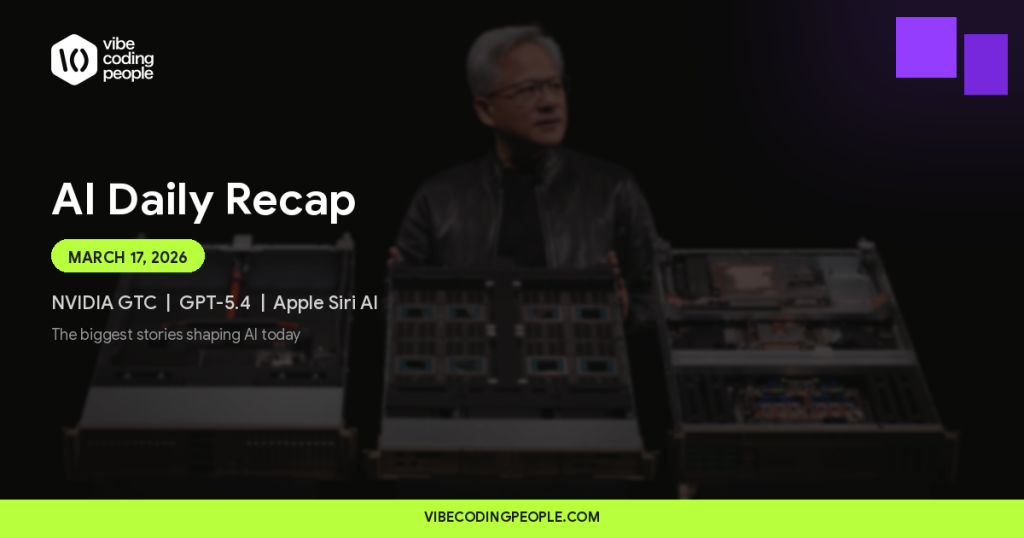
March 17, 2026 — It’s been another packed day in the world of artificial intelligence. From NVIDIA’s flagship conference to billion-dollar market swings and new model capabilities rolling out across the industry, here’s what you need to know.
NVIDIA GTC 2026: The Main Event
NVIDIA’s annual GTC conference is in full swing, and the announcements keep coming. Today’s highlights include RTX-accelerated computers connecting directly to Apple Vision Pro for advanced spatial computing, new AI Grid infrastructure for telecom networks built in collaboration with major carriers, and expanded support for running open-source AI models and agents locally on RTX PCs and DGX Spark systems.
CEO Jensen Huang has outlined a roadmap targeting $1 trillion in AI chip revenue through 2027, and the market is responding — NVIDIA shares rose 2.19% today, lifting the broader Dow Jones by 523 points. The company also unveiled the Rubin platform, its next-generation supercomputer architecture set to succeed Blackwell, signaling the most significant hardware shift since the Transformer architecture was introduced.
In a notable strategic pivot, Huang confirmed that NVIDIA will stop investing in OpenAI and Anthropic, citing the companies’ plans to go public later this year — a move that has raised more questions than it answers.
The $1 Trillion Value Wipe-Out
On the flip side, major AI-linked stocks have taken a serious hit. Amazon, Oracle, and other tech giants have collectively shed roughly $1 trillion in market value in recent sessions. The correction reflects growing investor uncertainty about whether the massive capital expenditures pouring into AI infrastructure — Amazon alone announced $200 billion in planned capex for 2026, followed by Alphabet at $180 billion and Microsoft at $155 billion — will translate into proportional returns.
Model Wars: GPT-5.4, Qwen 3.5, and the Chinese Challenger Wave
The model landscape continues to evolve rapidly. OpenAI’s GPT-5.4, launched earlier this month, scored 83% on the GDPVal benchmark — placing it at or above human-expert level on economically valuable tasks. It supports up to 1.05 million tokens of context and includes native computer-use capabilities.
Meanwhile, Chinese AI labs are surging. Alibaba’s Qwen 3.5 handles multimodal inputs including videos up to two hours long. MiniMax’s M2.5 model is being praised for rivaling Anthropic’s Claude Opus 4.6 at a fraction of the cost. In total, five major models from Tencent, Alibaba, Baidu, and ByteDance have dropped this month alone.
NVIDIA’s own Nemotron 3 Super, announced at GTC, achieved the highest open-weight score on SWE-Bench Verified (60.47%) — a 120-billion-parameter hybrid model that uses only 12 billion active parameters per forward pass.
Apple’s AI-Powered Siri Relaunch
Apple confirmed a completely reimagined Siri powered by Google’s 1.2 trillion parameter Gemini model. The new assistant promises on-screen awareness and seamless cross-app integration, running on Apple’s Private Cloud Compute infrastructure. The update is expected to arrive alongside iOS 26.4 later this month.
SpaceX-xAI Merger and Industry Moves
In one of the more unexpected developments, Elon Musk’s SpaceX has acquired xAI in an all-stock transaction valuing the AI venture at $50–80 billion. The plan is to embed xAI’s Grok models directly into Starship control systems, satellite networks, and Mars mission planning.
In other deal news, voice AI startup ElevenLabs secured $500 million at an $11 billion valuation, and Anthropic launched the Claude Partner Network with a $100 million commitment to enterprise transparency and safety.
Ethics and Regulation
The policy landscape is heating up. Anthropic and the Pentagon remain at a stalemate over military AI usage, with Anthropic drawing a hard line against mass surveillance and autonomous weapons without human oversight. In the UK, a new parliamentary report called generative AI a “clear and present danger” to copyright holders, pushing for a licensing-first approach to training data. Meanwhile, UK Research and Innovation committed £1.6 billion over four years to anchor AI in British science policy.
The Big Picture
March 2026 is shaping up as one of the most consequential months in AI history. The industry is shifting from pure capability races to deployment reality: can these systems perform reliably in production, and do the business models hold up? Gartner projects worldwide AI spending will hit $2.52 trillion this year. The agentic era — where AI systems make decisions and carry out multi-step tasks independently — is no longer a roadmap item. It’s happening now.
Stay tuned for tomorrow’s recap. The pace isn’t slowing down.





Responses