AI News Week #16


If you spent any of the past seven days wondering whether the AI industry might finally take a breath, the week of April 13–19 had a clear answer: not even close. Across seven days we got a brand-new GPT, a new Claude flagship, a new NVIDIA model, a new Google open-source family, a new Anthropic cybersecurity bombshell, the most significant AI Index report Stanford has ever published, a $300 billion venture quarter, a federal ruling that AI chats are not privileged, the largest workforce-and-AI layoff yet, and yes — Mark Zuckerberg deciding the world also needs an AI clone of himself. It was the kind of week where the Big Picture section felt incomplete by Wednesday.
Here’s how it all fits together.
The frontier shipped — all of it, all at once

The headline event was OpenAI shipping GPT-6 globally on April 14. The model isn’t just a benchmark bump — it introduces a two-tier inference architecture where a fast System-1 generates while a slower System-2 quietly verifies multi-step reasoning in the background. OpenAI claims hallucination rates below 0.1 percent and HumanEval scores above 95 percent, a roughly 40 percent jump over GPT-5.4. The pricing held at $2.50 per million input tokens and $12 per million output tokens, which is the more interesting story: the cost-per-capability curve is still bending, hard. GPT-6 is also the engine behind the long-promised unification of ChatGPT, Codex, and the Atlas browser into a single desktop agent.
Five days later Anthropic answered with Claude Opus 4.7, focused squarely on the engineering tier where most of Anthropic’s enterprise revenue lives. Vision capability tripled — Opus 4.7 now ingests images up to 2,576 pixels on the long edge, which is enormous for diagram analysis and computer-vision agents. There’s a new “xhigh” effort level for extended reasoning that lets developers explicitly trade latency for depth, and the model lit up across the Claude API, Bedrock, Vertex AI, and Microsoft Foundry on day one at the same $5/$25 per million pricing. Read between the lines and the strategy is clear: OpenAI took the consumer headline; Anthropic kept its grip on the enterprise coding workflow.
That wasn’t the only Anthropic story rattling the industry this week. The Claude Mythos aftershocks kept reverberating through the cybersecurity sector. Anthropic confirmed Mythos is its most capable model ever, then refused to ship it — instead distributing it through a closed program called Project Glasswing to roughly 40 organizations including Microsoft, Apple, Google, JPMorgan Chase, and CrowdStrike, with $100 million in usage credits attached. The preview has reportedly already surfaced thousands of high-severity flaws across every major operating system and browser. Cybersecurity equities sold off again on Tuesday as investors absorbed the implication that the next big offensive AI is already loose inside a small, defensive perimeter — and patching, not finding, is the bottleneck.
Meanwhile NVIDIA shipped Nemotron 3 Super, a 120B-parameter Mixture-of-Experts model that activates just 12B parameters at inference using a hybrid Mamba-Attention architecture. The throughput numbers are obnoxious — up to 2.2x faster than other 120B-class models, 5x faster than its predecessor, with a native 1M-token context window. And it’s fully open: weights, datasets, training recipes, all under permissive terms. Google, not to be left out, released Gemma 4 under Apache 2.0, including a 31B dense variant that punches against models 20x its size, plus a 2B model designed to run on a smartphone or even a Raspberry Pi. Meta’s first model from its new Superintelligence Labs, Muse Spark, kept rolling out across WhatsApp, Instagram, Facebook, Messenger, and the company’s AI glasses.
If you stack those releases against each other, the pattern is interesting. OpenAI is pushing the closed-frontier consumer/agent surface. Anthropic is pushing the closed-frontier enterprise/safety surface. NVIDIA and Google are pushing the open-weights efficiency surface. Meta is pushing the social-distribution surface. The “AI race” stopped being one-dimensional somewhere in late 2025, and this week made the new map legible.
Stanford’s AI Index landed like a bomb
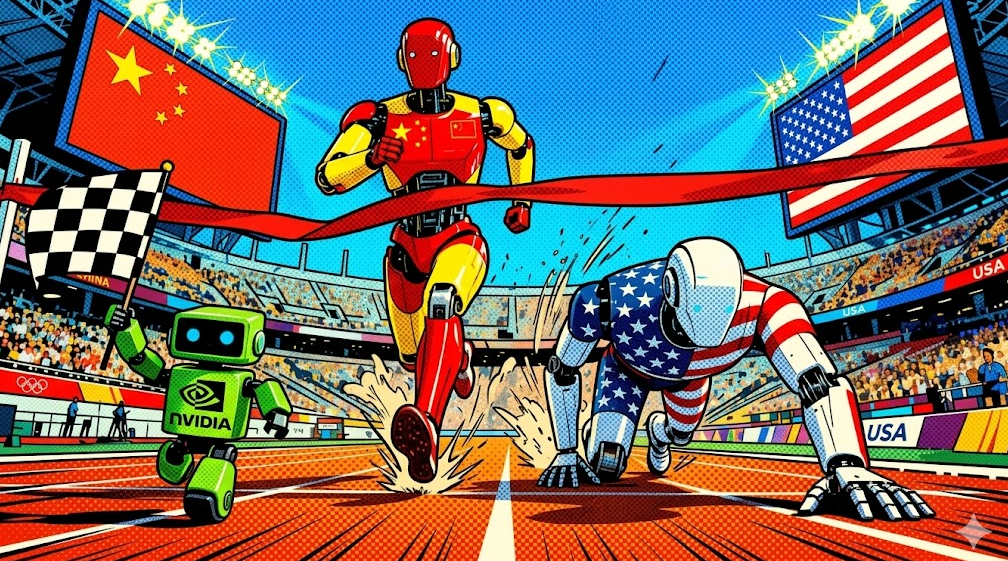
If you only read one document about AI this year, make it the 2026 AI Index, dropped on Monday by Stanford HAI. Three numbers tell the story.
The first number is 2.7. As of March, the gap between Anthropic’s best frontier model and China’s best — ByteDance’s Dola-Seed Preview — was just 2.7 percentage points on the Arena benchmark. The two countries’ models have been trading the lead since early 2025. America is no longer ahead in any meaningful, sustained sense; the lead in capability that drove the entire policy conversation in 2023 and 2024 is functionally gone. Stanford was careful to note that the U.S. still leads on hardware control, private capital, and talent concentration, but those are the moats around the castle, not the castle.
The second number is 40. The Foundation Model Transparency Index — the same index that hit 58 in last year’s report — fell to 40. Frontier labs are publishing less about training data, less about parameter counts, less about safety evals, and less about everything else. The most capable models in the world are also the least legible to outsiders. Stanford framed this as a structural risk for both regulation and research, and it’s hard to disagree.
The third number is 53 percent. That’s the share of the global population now using generative AI roughly three years after ChatGPT’s launch — a faster diffusion than the PC or the internet. But adoption isn’t conviction: 59 percent feel optimistic about AI’s benefits and 52 percent feel nervous, often the same people on the same day. TechCrunch’s reading of the report — the widening gap between AI insiders and “everyone else” — felt like the dominant subtext of the entire week.
The Index also underlined two trend lines that matter. First, SWE-bench Verified coding scores climbed from 60 percent to nearly 100 percent in twelve months. We blew through the saturation point on the most-watched coding benchmark in the world while no one was looking. Second, U.S. private AI investment hit $285.9 billion in 2025 — still 23 times China’s total. So the capability gap closed even as the capital gap stayed wide, which is its own uncomfortable signal about how efficiently China is converting investment into model performance.
The most concentrated capital event in tech history
Speaking of capital. Crunchbase’s Q1 2026 numbers, which the daily recaps returned to all week, are not normal venture data. They are something closer to a phase change.
Q1 global venture funding hit roughly $300 billion across 6,000 startups. Four of the five largest venture rounds in history closed in a single quarter: OpenAI’s $122 billion at an $852 billion post-money valuation, Anthropic’s $30 billion Series G at a $380 billion post, xAI’s $20 billion, and Waymo’s $16 billion. AI absorbed roughly 81 percent of all venture deployed worldwide. Foundational-model funding alone in Q1 was double the entirety of 2025.
OpenAI’s round in particular reshaped the capital stack. Amazon wrote the largest check at $50 billion. NVIDIA and SoftBank each put in $30 billion. For the first time, OpenAI cracked the door open for retail investors, raising $3 billion through bank channels — clearly setting up an IPO arc. The operating metrics OpenAI disclosed were the real flex: $2 billion a month in revenue, 15 billion tokens per minute on the API, with enterprise now 40 percent of the top line and closing in on parity with consumer.
And the deals didn’t stop on the model side. On Saturday, OpenAI committed more than $20 billion to AI chipmaker Cerebras over three years, expanding a $10 billion January deal, plus warrants for up to a 10 percent equity stake. Cerebras simultaneously filed for a Nasdaq IPO targeting a $35 billion valuation. Inference, not training, is now expected to drive two-thirds of AI compute spending by year-end — and OpenAI is locking up alternative silicon before everyone else figures that out. Factory raised $150 million at a $1.5 billion valuation to build enterprise coding “Droids,” now used by developers at NVIDIA, Adobe, MongoDB, and Zapier.
Underneath the frothy numbers, the most revealing story might have been the OpenAI internal memo obtained by Implicator.ai in which OpenAI’s chief revenue officer accused Anthropic of overstating its $30 billion run rate by roughly $8 billion through gross-revenue accounting that includes reseller pass-throughs. When the incumbent stops attacking the model and starts attacking the income statement, you know the race for enterprise share has gotten close. Corporate-spending data this week showed Anthropic on track to pass OpenAI in enterprise customer share within two months.
The workforce shoe finally dropped
For two years the question on every keynote stage has been: when does AI actually move the headcount line? This week we got an unmistakable answer.
Snap announced it is laying off roughly 1,000 employees, about 16 percent of its workforce, while closing more than 300 open roles. CEO Evan Spiegel wrote that the company is at a “crucible moment” and openly attributed the cuts to AI: more than 65 percent of Snap’s new code, he said, is now written by AI. The company expects to take more than $500 million out of its annualized cost base by the second half of 2026. Affected U.S. employees get four months of severance, healthcare, and equity vesting. Snap’s stock jumped roughly 7 to 11 percent over the week as investors clapped at headcount discipline packaged in an AI narrative. (Reuters separately reported that Meta is contemplating cuts of up to 20 percent to offset AI infrastructure costs. Just stating that out loud.)
In parallel, Gallup released new workforce data showing that for the first time, half of employed Americans say they use AI in their job at least a few times a year. Thirteen percent now use it daily, 28 percent at least a few times a week. PwC’s 2026 AI Performance Study, released the same day, lobbed in the headline boardrooms have been waiting for: just 20 percent of companies are now capturing roughly three-quarters of AI’s measurable financial gains. The firms restructuring incentives and reporting lines around AI-first workflows are pulling away on margin, valuation, and talent. Everyone else is being lapped.
And then, lurking under all the macro data, was the smaller and weirder Fortune number: 80 percent of enterprise workers are still avoiding or actively resisting AI tools. Gartner’s parallel survey found only 28 percent of enterprise AI use cases in infrastructure and operations are fully meeting ROI expectations, with 20 percent failing outright. So we have an environment in which executives are deploying AI at peak velocity, the macro adoption charts are nearly vertical, and a substantial majority of individual workers are quietly opting out. The Snap and Meta layoffs are an early read on which side of that tension will get resolved first.
The week’s most surreal entry sat right next to all this: Meta is reportedly building a photorealistic AI clone of Mark Zuckerberg. It is being trained on his mannerisms, communication style, and views on company strategy. He is reportedly spending five to ten hours a week on the project. Employees would interact with it when the real Zuck is unavailable. Pair that with the rumored 20 percent layoffs and you can see why Meta staffers are nervous. We have officially crossed the line from “AI takes over coding” into “AI takes over presence.”
The legal system started catching up
For most of the LLM era, the legal system has been a step behind. This week it took several large steps forward, not all of them comfortable for AI users.
U.S. District Judge Jed Rakoff ruled flatly that conversations with AI chatbots are not protected by attorney-client privilege. The case involved GWG Holdings’ Bradley Heppner, who had used Claude to help prepare legal documents in a securities fraud defense. Rakoff ordered disclosure of 31 AI-generated documents and wrote that no attorney-client relationship “exists or could exist” between a user and an AI platform. More than a dozen major U.S. firms reportedly issued client warnings within days, and at least one — Sher Tremonte — has already added contractual language about AI disclosure risk to its engagement letters.
Meanwhile, in Nebraska, the state Supreme Court temporarily suspended Omaha attorney Greg Lake after his appellate brief in a divorce case turned out to contain 57 defective citations out of 63 — including 20 outright AI hallucinations with fabricated cases and quotations. His denial of using AI was found to “lack credibility.” Per The Ethics Reporter, U.S. courts imposed at least $145,000 in sanctions on attorneys for AI citation errors in Q1 alone, even as a parallel survey showed 61 percent of federal judges are now using AI tools themselves. The bar is figuring this out in real time, with real consequences.
The Mobley v. Workday case, the most-watched AI hiring lawsuit in the country, was certified to proceed as a nationwide collective action under the Age Discrimination in Employment Act. The plaintiff, Derek Mobley, submitted more than 100 applications through Workday’s platform and was rejected every single time, often within minutes, often in the middle of the night, never once getting an interview. The court rejected Workday’s argument that applicants aren’t entitled to disparate-impact protection. Combined with the EU AI Act now classifying all AI recruitment tools as “high-risk,” every company running automated hiring screens is suddenly carrying meaningful legal exposure.
And on the legislative front, three more states passed AI bills last week alone — Nebraska’s LB 525 (chatbot disclosure to minors), Maryland’s HB 895 (algorithmic pricing), and Maine’s LD 2082 (AI therapy restrictions) — while Hawaii, Oklahoma, California, and Connecticut all advanced chatbot legislation, and California pushed three healthcare AI bills. In the absence of any comprehensive federal AI law, the state-level patchwork is starting to look like the actual policy framework for the U.S.
The agentic era stopped being a slide

For most of 2025, “agentic AI” was something venture decks promised would arrive Real Soon Now. This week was the moment the agent thesis stopped being a slide and started being a product line.
Perplexity launched “Personal Computer” for Mac, an agentic OS layer for Perplexity Max subscribers ($200/month) that orchestrates teams of agents across more than 20 frontier models, autonomously manages files, navigates apps, and executes multi-step workflows. Perplexity is openly recommending users dedicate a Mac mini to running it always-on. Every action is auditable, reversible, and gated with a kill switch — but the pitch is unambiguous: this is your second computer, and the first one is for humans.
Canva dropped Canva AI 2.0 at its Create conference in LA, repositioning itself from a design tool to “an agentic platform for the workplace.” The update unifies a conversational interface over Canva’s own model stack — Proteus for style transfer, Lucid Origin for image generation, I2V for image-to-video — which the company claims runs up to 7x faster and 30x cheaper than the closest frontier alternatives. The opening rollout targets the first million users.
Anthropic, separately from the Opus 4.7 release, was reportedly preparing an AI-powered design tool that lets users build websites, presentations, and landing pages from plain English. The leak alone sent Adobe, Figma, and Wix shares down more than 2 percent — a useful market reaction to file away for the next time someone tells you “incumbents always win.”
Stellantis and Microsoft signed a five-year strategic partnership across more than 100 AI initiatives, targeting a 60 percent reduction in datacenter footprint by 2029, with Microsoft 365 Copilot already deployed to 20,000 Stellantis employees. Novo Nordisk — the maker of Ozempic and Wegovy — signed a partnership with OpenAI to deploy AI across R&D, manufacturing, and corporate operations, full integration targeted by year-end. And NVIDIA pushed its Vera Rubin platform into full production, anchoring deployments at AWS, Google Cloud, Microsoft, and Oracle in H2 2026. The infrastructure layer is being booked at scale.
The quieter stories worth holding
Two research items will probably matter more than the news cycle suggested.
The first is a Tufts University paper on neuro-symbolic AI that cut training energy by up to 100x while improving accuracy. On the Tower of Hanoi benchmark, the system hit 95 percent success against 34 percent for traditional models, and dropped training time from 36 hours to 34 minutes. Given that AI systems already eat more than 10 percent of U.S. electricity, this is the kind of efficiency story that, if it scales, changes the entire data-center capex curve.
The second is Anthropic’s Nature paper on subliminal learning — how large language models can transmit hidden traits, preferences, and biases through subliminal data signals that aren’t explicitly present in the training objective. As models keep getting wired into more high-stakes decisions, the “what’s actually in there” problem stops being theoretical. Pair it with the Stanford Transparency Index falling to 40 and you have a worrying combo: the most powerful models we have are also the most opaque, and we now have direct evidence they can carry behaviors no one explicitly trained.
And in the further-out research lane, Meta and KAUST published a paper proposing Neural Computers — an architecture in which the neural network is the computer, not just a layer running on top of one. It’s years away from anything practical, and it’s exactly the kind of foundational rethink the field will need if Moore’s-law substitutes don’t arrive.
The big picture
Three things changed shape this week. First, the U.S. lead in AI capability is gone — and Stanford’s data says it’s been gone for a while; the last twelve months were just when the rest of us caught up to that fact. Second, capital and revenue stopped flowing along the same curve. Q1 was the largest concentration of venture money toward a handful of frontier companies in history, while PwC quantified the divide that’s now opening between the 20 percent of companies actually monetizing AI and the 80 percent treating it as a productivity sidebar. Third, the workforce question stopped being theoretical: Snap showed what an AI-driven layoff pattern looks like, the legal system started drawing real lines around chatbot use, and Meta started building an AI replica of its CEO.
If you’re a builder reading this, the implication is bracing but clear. The agent layer is no longer a roadmap item; products like Perplexity Personal Computer, Canva AI 2.0, and Factory’s Droids shipped to actual users this week. The model layer is no longer the bottleneck; even open-weights options like Gemma 4 and Nemotron 3 Super are at frontier efficiency. The bottleneck is everything around the model — distribution, trust, change management, legal exposure, and incentive design. That’s an oddly familiar place to land. It’s also where the next year’s biggest fortunes (and biggest mistakes) are going to be made.
The Stanford report’s grimmest line might end up being its most prescient: AI is being “done to” the public faster than it’s being “done with” them. The companies and institutions that figure out how to flip that ratio — by making the technology legible, contestable, and worth trusting — will own this decade. The rest will spend it explaining headcount cuts in earnings calls.



Responses