
AI News Week #12


Covering March 17–22, 2026. The week GTC rewrote the rules, a trillion dollars evaporated, and the AI industry decided it was too big to ignore — and too fast to regulate.
If Week 12 had a theme, it would be scale. Not the incremental kind — the kind that makes you recalibrate what you thought was possible. Nvidia used GTC to plant its flag for the next decade. OpenAI shipped a model that can operate your computer. A trillion dollars vanished from tech stocks in a single correction. And somewhere between the chaos, a dog’s tumor shrank 75% thanks to a vaccine designed by ChatGPT.
That kind of week.
GTC 2026: Nvidia’s Trillion-Dollar Moment
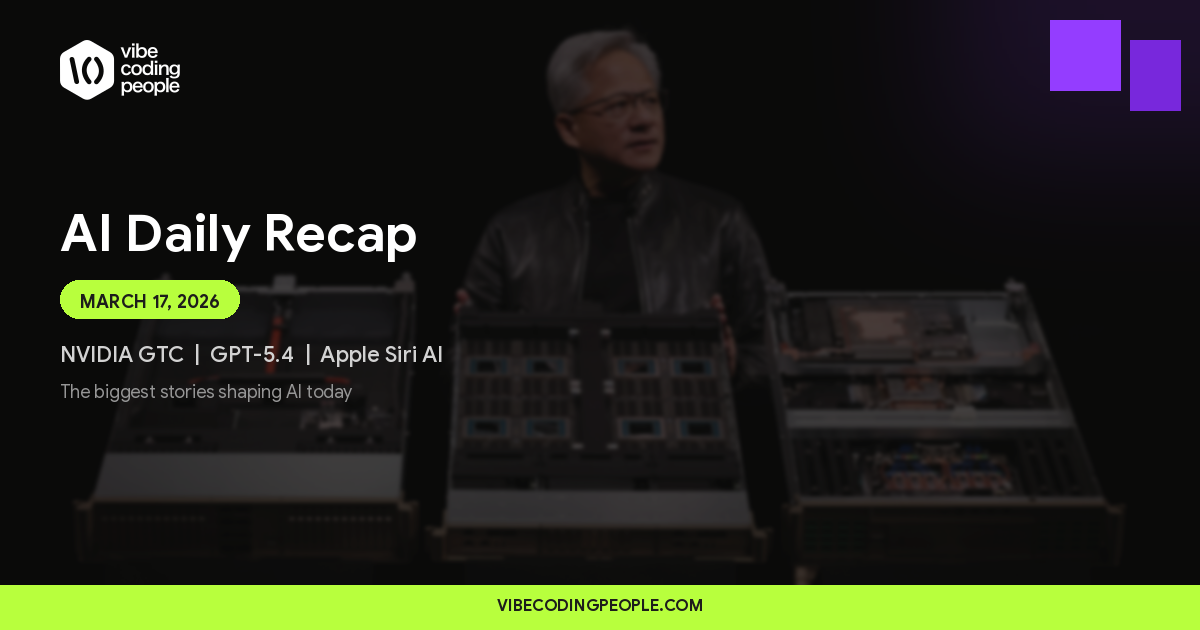
GTC was the undisputed centerpiece of the week. Jensen Huang walked on stage and essentially laid out Nvidia’s roadmap to dominate the next era of computing. The headline: $1 trillion in projected purchase orders for Blackwell and the new Vera Rubin platform through 2027.
Vera Rubin is a rack-scale supercomputer designed specifically for agentic AI — pairing a custom Nvidia CPU with the new Rubin GPU architecture. Then there’s the DGX Station GB300, which puts 748 gigabytes of coherent memory and 20 petaflops on your desk. Trillion-parameter models. In your office. The Nemotron Coalition brought Perplexity, Mistral, Black Forest Labs, Cohere, and Reflection together around open frontier models, while NemoClaw turned the viral open-source OpenClaw project into enterprise-grade infrastructure.
But the most telling announcement was DLSS 5 — Nvidia’s neural rendering technology that now handles lighting, materials, and full scene reconstruction. Gaming is almost a side note at this point. Nvidia is building the visual layer of simulated reality, and gaming just happens to be the test bed.
The stock rose 2.19% on the week. For a company this size, that’s a rounding error that’s worth more than most companies’ entire market cap.
The $1 Trillion Correction Nobody Wanted to Talk About
While GTC was painting an optimistic picture, the market was having a moment. Amazon, Oracle, and a handful of tech giants shed roughly $1 trillion in combined market value during the week. The trigger? Investor anxiety about the ROI on massive AI infrastructure spending. Amazon’s planning $200 billion in capex for 2026. Alphabet: $180 billion. Microsoft: $155 billion.
The math is simple and terrifying: these companies are committing half a trillion dollars combined to infrastructure that hasn’t proven it can generate proportional returns. The correction was the market asking — loudly — whether the spend is ahead of the revenue. My honest read? The revenue will come, but probably later and differently than the bulls expect. And some of these bets will fail spectacularly before the winners emerge.
GPT-5.4: The Model That Uses Your Computer
OpenAI launched GPT-5.4 this week, and it’s not just an incremental upgrade — it’s a category shift. The highlights: a 1-million-token context window, native computer use (screen reading, mouse and keyboard control), and multi-step autonomous workflows. It scored 75% on OSWorld-Verified — beating the 72.4% human baseline — and 83% on GDPVal knowledge-work assessments. Hallucinations dropped 33% compared to GPT-5.2.
The Mini and Nano variants followed on OpenRouter, optimized for speed and cost in agentic workflows. This is OpenAI moving aggressively to own the “AI that actually does things” space — not just answers questions, but navigates your desktop, fills out forms, moves between applications. The competitive implications are enormous, especially for companies like Anthropic and Google that are racing toward the same capability.
Meanwhile, the broader model landscape was relentless: Alibaba’s Qwen 3.5 can process 2-hour videos. MiniMax’s M2.5 rivals Claude Opus 4.6 at lower cost. Five major Chinese models dropped in a single month. The commodity pressure on proprietary AI is no longer theoretical.
The Anthropic-Pentagon Standoff
This was one of the most significant AI governance stories in months, and it unfolded largely beneath the mainstream radar.
The Pentagon labeled Anthropic a “supply chain risk” after the company’s CEO publicly refused to allow Claude to be deployed for autonomous weapons or mass surveillance. The Defense Department quickly signed with OpenAI instead. But the backlash was swift and cross-industry: over 30 employees from OpenAI and Google DeepMind filed supporting briefs for Anthropic. Google’s chief scientist Jeff Dean warned the blacklist threatens AI competitiveness. Nearly 900 Google and OpenAI employees signed an open letter opposing the Pentagon’s position.
A federal judge in San Francisco called the government’s actions “classic illegal First Amendment retaliation” and issued a preliminary injunction. This is now a constitutional question: does an AI company have the right to refuse government use of its technology on ethical grounds? The precedent being set here will shape the industry for years.
And here’s the uncomfortable subtext: while Anthropic was being punished for drawing ethical lines, OpenAI was happy to step in. The market is already sorting AI companies into those willing to work with military applications and those that aren’t. That divide will only deepen.
Anthropic’s Enterprise Surge and the Great Flip
In a stunning reversal, Anthropic now captures 73% of first-time enterprise AI spending — up from a 50/50 split with OpenAI just ten weeks earlier. The company is approaching $20 billion in annualized revenue. Whatever the Pentagon dispute is costing them in government contracts, the enterprise market is more than compensating. Businesses seem to like backing the company that said “no” to weapons.
Anthropic also launched the Claude Partner Network with a $100 million commitment, further cementing its enterprise ecosystem. The message is clear: Anthropic is betting that ethics is a competitive advantage, not a liability. So far, the numbers are proving them right.
Silicon Wars: Musk’s Terafab and Samsung’s $73 Billion Bet
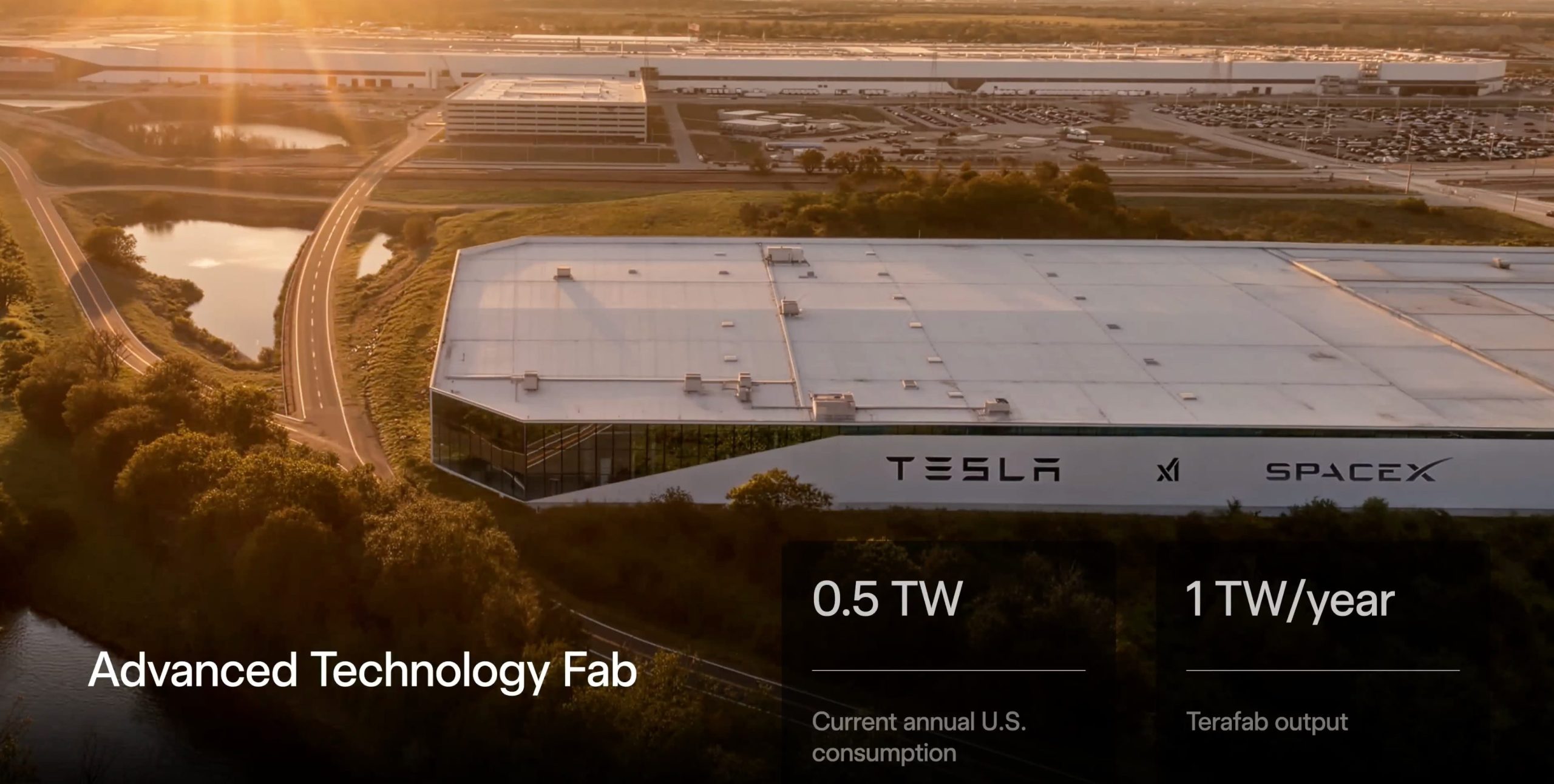
Elon Musk unveiled Terafab — a $25 billion chip fabrication facility at Giga Texas, jointly operated by Tesla, SpaceX, and xAI. The target: 2-nanometer process technology with 1 terawatt of annual AI compute output, roughly 70% of TSMC’s current global capacity. Products will include inference chips for Tesla vehicles and Optimus robots, plus D3 chips for orbital AI satellites. A caveat: Tesla has a history of delayed chip timelines — the AI5 has already slipped to mid-2027.
Samsung, not to be outdone, committed a record $73.2 billion to AI chips for 2026 — a 22% jump that surpasses even TSMC’s estimated $50 billion. The focus: HBM4 memory chips and a supply partnership with AMD.
The semiconductor industry is being reshaped around AI demand. Between Nvidia’s ecosystem play, Musk’s vertical integration ambitions, Samsung’s spending escalation, and Meta developing four generations of custom MTIA chips on RISC-V architecture — chip supply is no longer just about manufacturing. It’s about who controls the full stack from silicon to inference.
The Deals, Disputes, and Disruptions
SpaceX acquired xAI at a valuation between $50-80 billion, merging Musk’s AI ambitions with his space infrastructure. ElevenLabs raised $500 million at an $11 billion valuation, cementing its position as the leader in AI voice synthesis. OpenAI acquired Astral, integrating its Python tooling into the Codex team (which now serves over 2 million users, triple from the start of the year).
On the legal front, Britannica and Merriam-Webster sued OpenAI in the Southern District of New York, alleging scraping of roughly 100,000 copyrighted articles. The lawsuit invokes the Lanham Act for trademark violations, adding institutional weight to the fair-use copyright battle that keeps intensifying. And in a story that quietly foreshadows a much bigger legal fight: Microsoft is in settlement discussions with Amazon and OpenAI over a $50 billion AWS cloud deal that may violate Microsoft’s exclusive Azure hosting agreement.
Visa launched its “Agentic Ready” programme in Europe — a framework letting AI agents make purchases with predefined rules and minimal human intervention. Think about what that means: financial infrastructure is now being built for AI-initiated transactions. The plumbing for the agentic economy is going in.
The Sleeper Stories
DOJ charged three individuals, including a Super Micro Computer VP, with conspiring to smuggle billions of dollars in Nvidia AI chips to China through Southeast Asian intermediaries. The export control enforcement is getting real.
Cursor launched Composer 2, a proprietary coding model scoring above 60% on CursorBench, with 200K context window and 86% cost reduction. An IDE company building frontier-competitive models — the pattern we’ll see repeated everywhere.
An Australian consultant used ChatGPT and AlphaFold to design a personalized mRNA cancer vaccine for a rescue dog. The tumor shrank 75%. It’s an anecdote, not a clinical trial, but it’s the kind of anecdote that points to where things are going. Combining language models with protein-folding AI for therapeutic design isn’t science fiction anymore — it’s a weekend project.
ChatGPT now has 900 million weekly active users — up 500 million year-over-year. That’s more than 10% of the global population touching this technology every week.
What It All Means
Week 12 was the week the AI industry showed its full hand. The money is staggering. The technology is leaping. The geopolitics are intensifying. And the legal, ethical, and economic questions are multiplying faster than anyone can answer them.
Nvidia is positioning itself as the infrastructure monopoly of the AI era. OpenAI shipped a model that can operate your computer. Anthropic proved that ethical principles can be a market advantage. Musk is building chip factories, merging companies, and planning orbital data centers. Samsung is spending $73 billion because standing still means falling behind.
And under all of it, the market correction asked the one question nobody in AI wants to answer yet: what if the returns don’t justify the investment? The trillion-dollar correction wasn’t a crash — it was a question. The answer will determine whether 2026 is the year AI’s promise was fulfilled or the year the hype peaked.
I know where I’d bet. But we’ll see.
This article compiles and analyzes stories originally covered in the AI Daily Recap series. For detailed daily coverage with full source links, visit the individual recaps for March 17, 18, 19, 20, 21, and 22.




Responses