
April 28, 2026 – AI Daily Recap

The AI landscape shifted in several directions over the past 24 hours: a geopolitical intervention blocked one of the year’s biggest acquisitions, a Chinese upstart slashed prices to a fraction of Western competitors, Google doubled down on custom silicon for the agentic era, a robot made sports history, and two of tech’s most consequential partners rewrote the terms of their relationship. Here’s what you need to know.
China Blocks Meta’s $2 Billion Acquisition of Manus
China’s National Development and Reform Commission ordered the cancellation of Meta’s roughly $2–3 billion acquisition of Manus, the Singaporean AI agent startup with Chinese roots. The decision marks one of Beijing’s most significant interventions in a cross-border tech deal and signals the intensifying US-China AI rivalry. Meta had announced the acquisition in December 2025, with plans to fold Manus’s autonomous agent technology directly into Meta AI. But China’s Ministry of Commerce launched a probe in January, citing concerns over export controls and technology sovereignty. Complicating matters further, Meta had already integrated Manus into its internal systems and onboarded its executives — making any unwind messy and unprecedented.
DeepSeek Launches V4 and Ignites a Price War
Chinese AI lab DeepSeek released V4, its long-awaited flagship model, in two variants: V4-Pro and V4-Flash. The model introduces a Hybrid Attention Architecture that enables a 1-million-token context window, major upgrades to reasoning and agentic capabilities, and performance that DeepSeek claims outstrips GPT-5.2 and Gemini 3.0 Pro on select benchmarks. Then on April 27, DeepSeek slashed V4-Pro pricing by 75% and cut input cache costs across its entire API to one-tenth of previous rates — with promotional pricing as low as $0.0036 per million tokens. For context, Western competitors charge $12–25 per million output tokens. The open-source model is available for anyone to download, use, and modify.
Google Unveils TPU 8t and TPU 8i for the Agentic Era
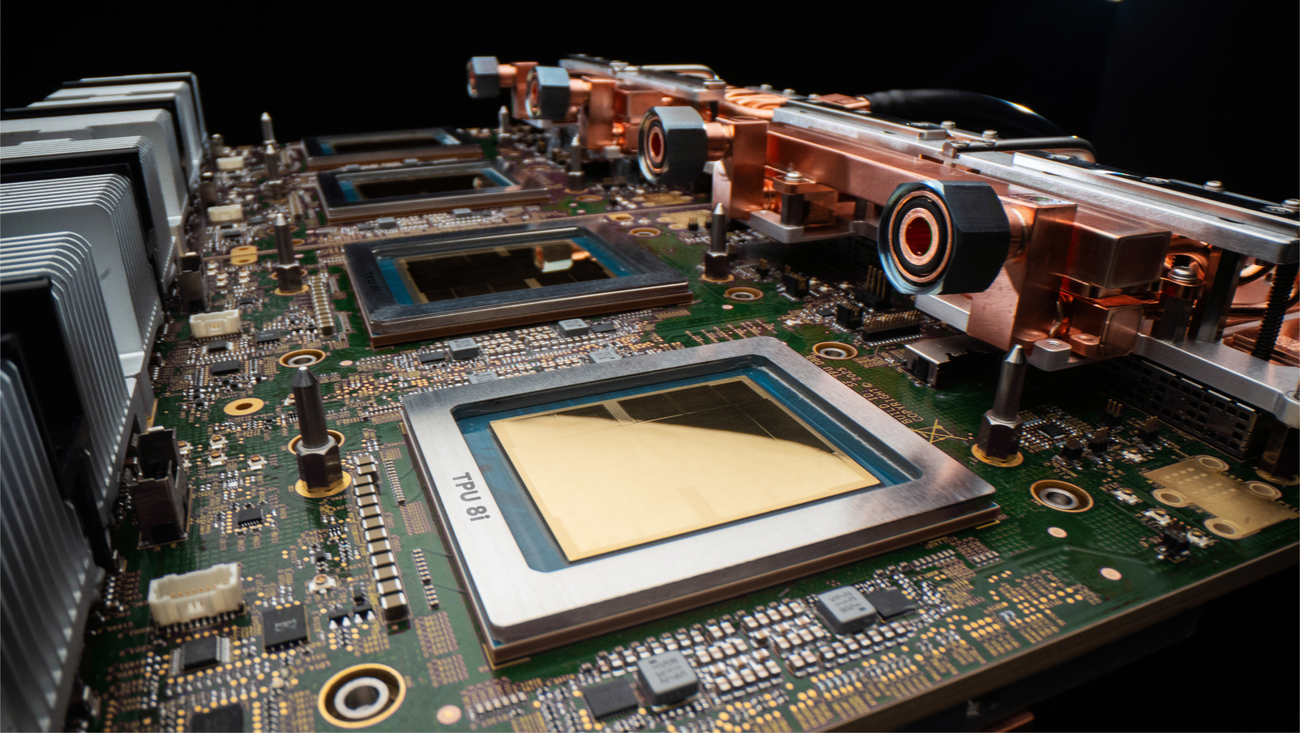
At Cloud Next ’26, Google introduced its eighth-generation Tensor Processing Units with a twist: two distinct architectures purpose-built for different workloads. The TPU 8t targets training, with a single superpod scaling to 9,600 chips and 121 ExaFLOPs of compute — aiming to compress frontier model development from months to weeks. The TPU 8i specializes in low-latency inference for AI agents, delivering 80% better performance-per-dollar than its predecessor, allowing companies to serve nearly twice the customer volume at the same cost. Both chips will be generally available later this year and represent Google’s sharpest challenge yet to Nvidia’s dominance in AI silicon.
Sony’s Robot Defeats Professional Table Tennis Players
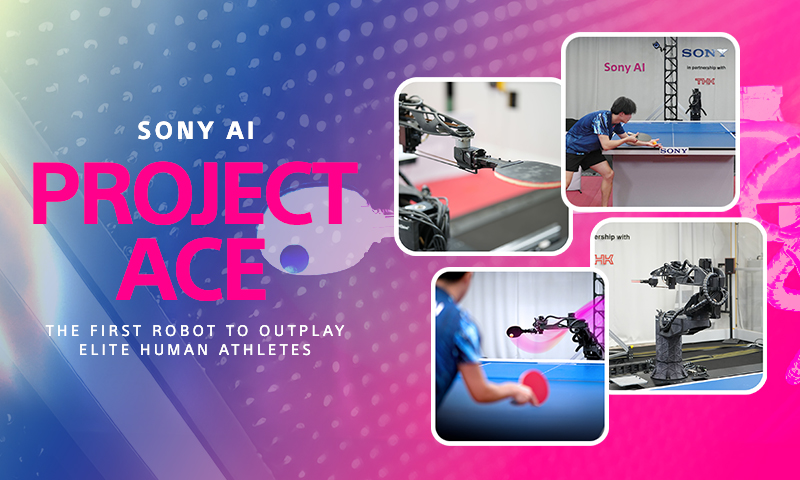
Sony AI’s Project Ace earned the cover of Nature with a milestone that robotics researchers have chased for decades: the first autonomous system to compete at an expert level in a physical sport. The robot defeated elite amateur players who train 20+ hours a week, winning three out of five matches — and in March 2026 testing, beat all three professional opponents at least once. Ace uses nine high-speed cameras to track ball position in 3D, event-based sensors for spin detection, and a fully articulated arm on a four-directional track system. The achievement demonstrates that AI-powered robotics can now operate with the speed, precision, and adaptability required for real-world physical tasks far beyond factory floors.
Microsoft and OpenAI Rewrite Their Partnership Terms

OpenAI and Microsoft announced a major restructuring of their partnership. Under the new terms, Microsoft will no longer pay a revenue share to OpenAI, while OpenAI’s payments to Microsoft continue through 2030 but are now subject to a total cap. Crucially, OpenAI gains multi-cloud freedom — it can now serve all its products across any cloud provider, not just Azure. Microsoft retains a (now non-exclusive) license to OpenAI’s IP through 2032. The shift was partly driven by OpenAI’s expanded partnership with Amazon, with AWS becoming a major distribution channel. As OpenAI’s revenue chief put it in a recent memo, the previous arrangement had “limited our ability to meet enterprises where they are.”
ICLR 2026 Wraps Up in Rio with a Clear Message
ICLR 2026 concluded its run in Rio de Janeiro after four days of presentations, with 3,462 papers accepted from nearly 11,617 submissions (a 29.8% acceptance rate). The Outstanding Paper award went to “Transformers are Inherently Succinct,” a theoretical work explaining why Transformers can encode concepts more compactly than RNNs. An Honorable Mention highlighted a paper on multi-turn LLM evaluation that found a “marked decrease in LLM aptitude and reliability” when conversations become multi-turn with underspecified instructions — a finding with implications for anyone building agent systems. The conference’s overarching theme: “The era of model construction has ended; we are now entering the era of model application and governance.”
The Big Picture
Today’s headlines trace two forces pulling the AI industry in opposite directions. On one side, consolidation and control: China exerting extraterritorial reach to block a completed deal, Microsoft and OpenAI redrawing commercial boundaries, Google building proprietary silicon empires. On the other, radical openness and competition: DeepSeek open-sourcing a frontier-class model and pricing it at a fraction of Western rates, ICLR publishing thousands of papers freely. Meanwhile, Sony’s table-tennis robot and Google’s inference-focused TPU 8i both point toward the same destination — AI that acts in the physical world, in real time, at scale. The question is no longer whether AI can match human performance, but who gets to control how and where it does.
Sources
- China blocks Meta’s $2 billion takeover of AI startup Manus – CNBC
- China vetoes Meta’s $2B Manus deal after months-long probe – TechCrunch
- Xi Tests China’s Reach by Blocking Already-Done Meta Deal – Bloomberg
- DeepSeek previews new AI model that ‘closes the gap’ with frontier models – TechCrunch
- Three reasons why DeepSeek’s new model matters – MIT Technology Review
- DeepSeek Slashes Fees for New AI Model in Chinese Price War – Bloomberg
- Our eighth generation TPUs: two chips for the agentic era – Google
- Google Cloud launches two new AI chips to compete with Nvidia – TechCrunch
- Sony AI Announces Breakthrough Research in Real-World AI and Robotics – Sony AI
- Scientists Built a Robot That Can Beat Elite Human Players at Table Tennis – ScienceAlert
- OpenAI shakes up partnership with Microsoft, capping revenue share payments – CNBC
- The next phase of the Microsoft OpenAI partnership – OpenAI
- OpenAI ends Microsoft legal peril over its $50B Amazon deal – TechCrunch
- Announcing the ICLR 2026 Outstanding Papers – ICLR Blog
- ICLR 2026 Papers – ICLR



Responses