
Microsoft Maia 200: The Inference Revolution That Changes Everything

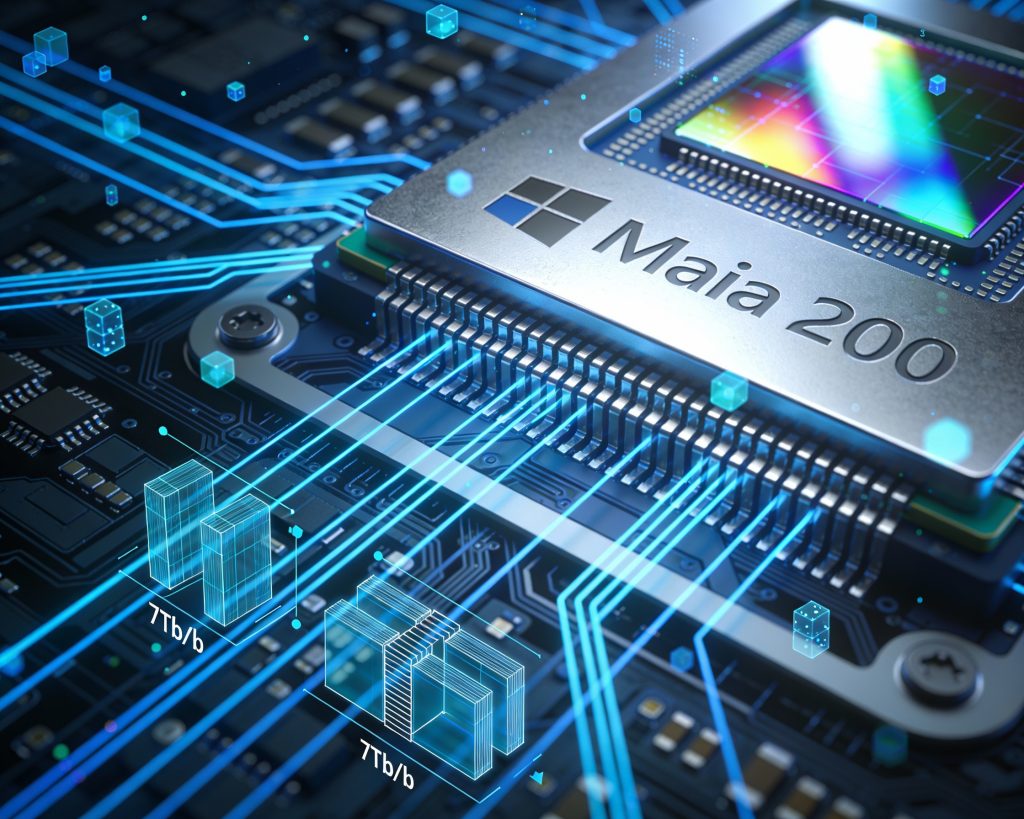
On January 25, Microsoft quietly released a bombshell that could reshape the entire economics of AI. Maia 200, a custom-built inference accelerator, has achieved three times the FP4 performance of Amazon’s third-generation Trainium and delivers 30% better cost-per-token than any current hardware in Microsoft’s fleet. This is not a minor incremental upgrade—it is a fundamental restructuring of how AI models run at scale.
The Memory Bottleneck Solved
The real innovation lies not in raw computational power, but in solving the most brutal problem plaguing AI deployment: feeding data to the chips fast enough. Maia 200 features 216GB of HBM3e memory running at 7TB/s bandwidth, paired with 272MB of on-chip SRAM. This redesigned memory architecture specifically targets narrow-precision datatypes (FP8 and FP4), enabling models to run with massively reduced memory footprint while maintaining near-lossless accuracy. For every token generated, the bottleneck is no longer the computation itself but the speed at which that computation can access data.

Enterprise Impact
Built on TSMC’s 3nm process, Maia 200 is designed to run today’s largest models—including GPT-5.2—with “plenty of headroom for even bigger models in the future”. What this means practically: Microsoft can now deploy GPT-5.2 at a fraction of the cost per token that competitors are paying on less-optimized hardware. This advantage compounds across millions of API calls. For enterprises consuming billions of tokens monthly, the cost difference alone could shift purchasing decisions toward Microsoft Azure.
The Broader Significance
The release reveals a strategic pivot from chip-agnostic model development to vertical integration of silicon and software. Just as Apple controls the entire iPhone stack, Microsoft is now controlling the inference layer—ensuring that every token generated for Copilot users, enterprise applications, and synthetic data pipelines flows through hardware purpose-built for that task. This is the moment when AI economics stop being about “who has the best model” and become “who can deliver that model most efficiently to the customer.”




Responses