
April 21, 2026 – AI Daily Recap

Monday kicks off with a packed news cycle in artificial intelligence. MIT Technology Review is unveiling its first-ever authoritative AI watchlist today, ChatGPT suffered a significant outage over the weekend, and the race to build ever-larger language models continues with DeepSeek V4 approaching launch. Meanwhile, Congress is grappling with existential questions about AI regulation, and Stanford’s latest index paints a picture of an industry barreling forward at unprecedented speed. Here’s what you need to know.
MIT Technology Review Launches “10 Things That Matter in AI Right Now”

Today marks a new tradition in AI journalism. MIT Technology Review is publishing its inaugural “10 Things That Matter in AI Right Now” list, an authoritative snapshot of the technologies, trends, and movements reshaping the field. The list is being unveiled on stage at the EmTech AI conference on MIT’s campus and will be published online later today. Four items have already been previewed: AI companions, mechanistic interpretability, generative coding, and hyperscale data centers. The editorial team says the list will guide their reporting priorities throughout 2026, making it a barometer worth watching for anyone tracking where the industry is headed.
ChatGPT Goes Down for Thousands of Users Worldwide
OpenAI’s ChatGPT experienced a partial outage on Sunday, April 20, disrupting service for thousands of users across the globe. The issues began around 10:05 AM ET, with Downdetector logging over 8,700 reports in the UK and 1,900 in the US at peak. Login failures, broken conversations, voice mode, image generation, and the new Codex feature were all affected. OpenAI classified the event as a “partial outage” and declared it was “monitoring the recovery” by 12:48 PM ET. According to a TechRadar user poll, 63% of affected users reported issues accessing old conversations, while 27% couldn’t log in at all. Services returned to baseline roughly 90 minutes after the initial reports.
DeepSeek V4 Nears Launch with Trillion-Parameter Model on Huawei Chips

China’s DeepSeek is on the verge of releasing its V4 flagship model, a trillion-parameter Mixture-of-Experts architecture that activates only 37 billion parameters during inference, delivering a claimed 35x speedup and 40% energy reduction. The geopolitical angle is significant: Reuters confirmed that DeepSeek V4 will run on Huawei’s Ascend 950PR chips, making it the first frontier AI model built entirely on Chinese semiconductor infrastructure. The model will handle text, image, and video natively, and DeepSeek is expected to release the weights under an Apache 2.0 open-source license. Launch is expected in the latter half of April.
xAI Rolls Out Grok 4.3 Beta Behind a $300/Month Paywall
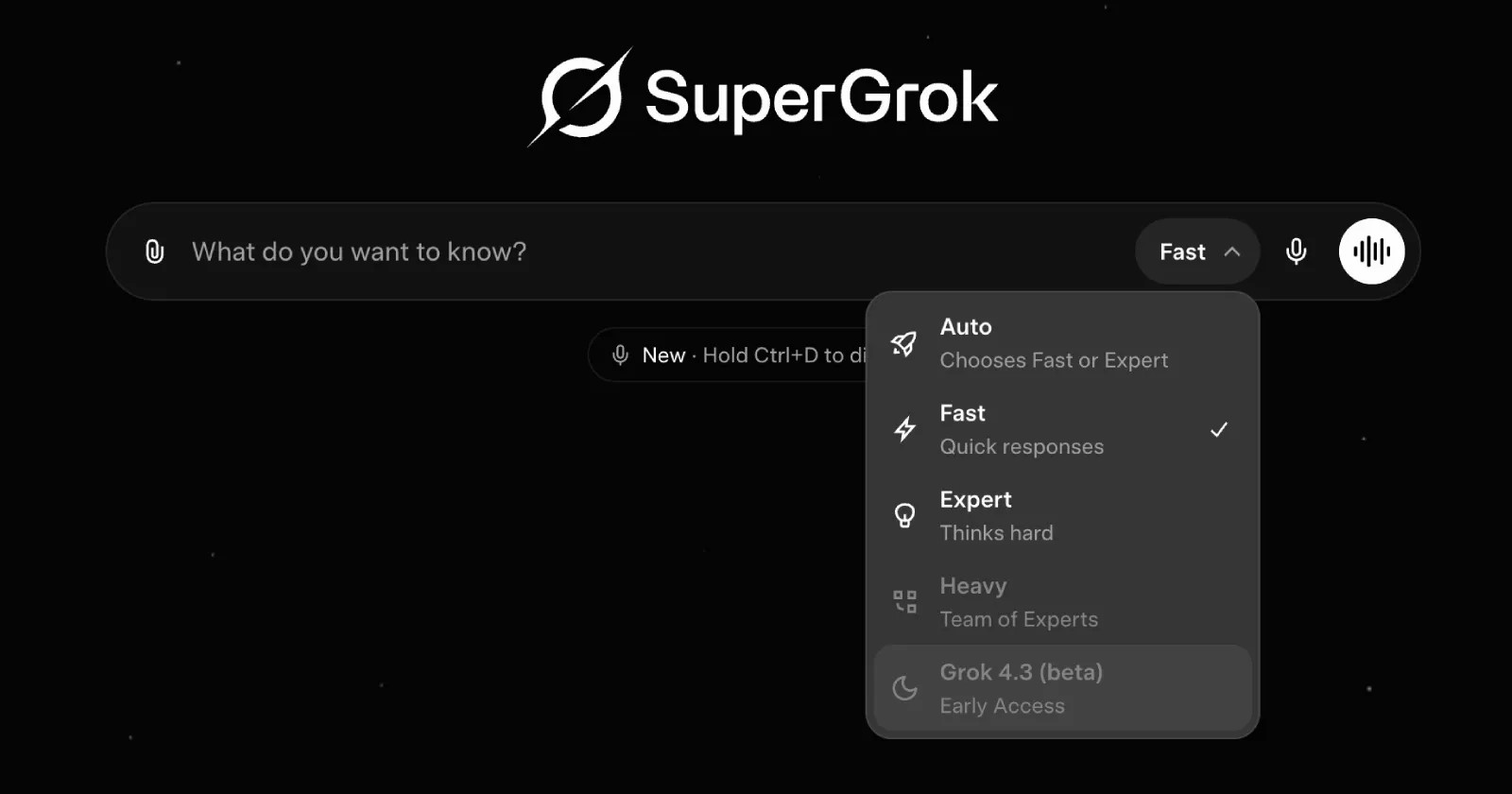
xAI quietly released Grok 4.3 Beta on April 17, but access is limited to SuperGrok Heavy subscribers paying $300 per month. The update introduces native video understanding, document generation (PDFs, spreadsheets, and slide decks), and tighter integration with Grok Computer, xAI’s desktop automation agent. Under the hood, Grok 4.3 retains the 16-agent Heavy architecture and 2-million-token context window from its predecessor. One glaring omission remains: there’s still no persistent memory between sessions, a feature competitors have offered for over a year. A broader rollout is expected in mid-to-late May 2026.
Stanford AI Index 2026: $581 Billion in Investment, Anthropic Leads Benchmarks

The Stanford AI Index for 2026 is out, and the numbers are staggering. Global AI investment hit a record $581 billion in 2025, more than doubling the prior year. World AI compute capacity has grown 3.3x annually since 2022, with Nvidia controlling over 60% of that capacity. On the benchmarks front, Anthropic currently leads in model performance, followed by xAI, Google, and OpenAI. LLMs have reached 50% accuracy on “Humanity’s Last Exam,” up from 8.8% just months ago, yet paradoxically still struggle with basic tasks like reading analog clocks. The environmental toll is also mounting: training Grok 4 alone produced an estimated 72,000 tons of CO2-equivalent, dwarfing GPT-4’s 5,184 tons. On adoption, the report notes that people are picking up AI faster than they adopted the personal computer or the internet.
Congress Sounds the Alarm: “Are We Engineering Our Own Destruction?”
A House Oversight subcommittee roundtable on April 16 laid bare just how anxious U.S. lawmakers are about AI. Rep. Eli Crane asked bluntly whether we “might be simultaneously engineering our own destruction.” Rep. James Walkinshaw raised alarms about federal workers feeding sensitive data into AI chatbots, while Rep. William Timmons questioned whether deepfake pornography should be criminalized. Rep. Maxwell Frost, Congress’s youngest member, warned that “the house is on fire” and that lawmakers may lack the technical competence to regulate the technology effectively. The hearing included testimony from industry executives and academics, but yielded no concrete legislative proposals, underscoring the gap between AI’s pace of development and Washington’s ability to respond.
The Big Picture
Today’s stories paint a familiar but intensifying picture. The models keep getting bigger (DeepSeek V4’s trillion parameters, Grok 4.3’s 16-agent architecture), the money keeps pouring in ($581 billion globally), and the governance conversation keeps struggling to keep pace. MIT Technology Review’s new watchlist is a timely acknowledgment that keeping score in AI now requires its own dedicated framework. Meanwhile, even the most established players aren’t immune to stumbles, as ChatGPT’s weekend outage reminded millions of users. The question Congress is asking, whether we’re engineering our own destruction, may be dramatic, but the pace at which these developments are stacking up makes it harder to dismiss.
Sources
- MIT Technology Review – 10 Things That Matter in AI Right Now
- TechRadar – ChatGPT Down April 2026
- ChinaBizInsider – DeepSeek V4 Targets April Launch
- GizChina – DeepSeek V4 Massive Parameter Scale
- SitePoint – DeepSeek V4 Released
- PiunikaWeb – xAI Grok 4.3 Beta for SuperGrok Heavy
- DEV Community – Grok 4.3 Review
- IEEE Spectrum – Stanford AI Index 2026
- Insurance Journal – Lawmakers Gather to Talk About AI
- Crypto Integrated – AI News April 20, 2026



Responses